

How Do You Switch Cat Litter Gradually?
Switch cat litter over 7-14 days by mixing the new litter into the old in rising ratios: about 25% new for days 1-3, 50% for days 4-6, 75% for days 7-9, then 100% from day 10. Each day, track three things: whether your cat uses the box, the number and size of urine clumps and stools, and any signs of avoidance. If your cat stops using the box, step back one stage for 2-3 days.
Cats are creatures of habit, and litter is one of the habits they care about most. A sudden change in texture or scent can lead to a cat holding urine, scratching at the box edge, or going on the carpet instead. A gradual switch, tracked day by day, removes the guesswork. You will know exactly when your cat is ready for the next step and spot problems before they become habits.
This guide gives you a printable cat litter switching checklist, a day-by-day transition schedule, a tracking log, and clear signs that mean slow down or call your vet. It is written by the JASON cat litter team using common feline behaviour guidance, and it works for any litter change, including a move to JASON cat litter.
Why Does a Gradual Cat Litter Change Matter?
A gradual change matters because cats judge a litter box by feel and smell, and an abrupt switch can trigger litter aversion. Litter aversion is one of the most common causes of inappropriate elimination, meaning urinating or defecating outside the box.
What Cats Notice When Litter Changes
- Texture underfoot. A cat used to fine sand-like granules may dislike larger or rougher pieces, and the reverse.
- Scent. A cat's sense of smell is far stronger than ours. Heavy fragrance or an unfamiliar mineral smell can put a cat off.
- Depth and digging feel. Clumping litter, non-clumping clay, silica, wood and paper all move differently when a cat digs and covers.
- Their own scent markers. Familiar litter carries the cat's scent, which signals "this is my toilet".
Common Reasons Owners Switch Litter
- Better odour control or clumping
- Less dust or tracking around the home
- Cost, bag size or easier storage
- A new kitten or adopted cat arriving on a different litter
- Vet advice, for example after urinary issues or surgery
Whatever the reason, the method is the same: mix, observe, record, then advance.
Before You Switch: The Pre-Switch Checklist
Complete this checklist before day 1 so you have a baseline to compare against. Without a baseline, you cannot tell whether a change in behaviour comes from the new litter.
- Record your cat's normal routine for 2-3 days: visits per day, urine clumps per day, stools per day
- Note the current litter type and brand, and roughly how deep you fill the box (most cats like 5-7 cm)
- Buy enough new litter for the full 14 days plus a week (see the bag size guide below)
- Keep at least half a bag of the old litter in reserve in case you need to step back
- Choose a calm fortnight, avoiding moving house, travel, building work, or a new pet
- Check your cat is healthy, with no recent urinary or bowel problems
- Follow the "one box per cat, plus one" rule if you have several cats
- Print or save the tracking log in this guide
- Tell everyone in the household which ratio you are on, so the box is topped up correctly
Expert tip: If your cat has a history of litter box problems, set up a second box with only the old litter. It gives your cat a familiar option, and its use tells you how the new mix is going.
The 7-14 Day Cat Litter Transition Schedule
Most cats accept new litter within 10-14 days when the new litter is introduced in four stages. Confident cats can move faster, in about 7 days, by spending 2 days per stage. Sensitive or senior cats may need 3-4 weeks.
| Days | Old litter | New litter | Move on when |
| 1-3 | 75% | 25% | Normal visits and clumps for 2+ days in a row |
| 4-6 | 50% | 50% | No digging hesitation or sniffing and leaving |
| 7-9 | 25% | 75% | Cat buries waste normally, no accidents |
| 10-14 | 0% | 100% | Routine matches your baseline for 3+ days |
How to Mix Old and New Litter
- Scoop the box fully before each stage.
- Mix the litters in a separate container or bag, not on top of each other in the box, so the blend is even.
- Fill to your cat's usual depth.
- Top up with the same ratio each day until the next stage.
- At 100%, do a full clean of the box with mild unscented soap and warm water, then refill with the new litter only.
Cold turkey or gradual? A gradual switch is the safer default. An instant switch can work for relaxed cats moving to a similar texture, but you lose the early warning that tracking gives you.
How to Track a Gradual Litter Change: The Daily Log
Track five signals once a day, ideally at the same scooping time. Comparing them with your baseline tells you whether to advance, hold, or step back.
What to Record Each Day
- Box visits: roughly how many times your cat used the box
- Urine clumps: count and size (a sudden drop or many tiny clumps is a red flag)
- Stools: number and whether they were buried
- Behaviour: digging, covering, sniffing then leaving, perching on the rim, quick exits
- Accidents: any urine or stools outside the box, and where
Example Tracking Log (Filled In)
This example shows one cat's 14-day switch. Its baseline was 4 urine clumps and 1 stool a day. Note the step back on day 7, which added 2 days to the switch.
| Day | New litter % | Urine clumps | Stools | Buried? | Hesitation? | Accidents | Decision |
| Baseline | 0% | 4 | 1 | Yes | No | None | Start switch |
| 1 | 25% | 4 | 1 | Yes | No | None | Hold |
| 2 | 25% | 4 | 1 | Yes | No | None | Hold |
| 3 | 25% | 4 | 2 | Yes | No | None | Advance |
| 4 | 50% | 3 | 1 | Yes | Slight sniffing | None | Hold |
| 5 | 50% | 4 | 1 | Yes | No | None | Hold |
| 6 | 50% | 4 | 1 | Yes | No | None | Advance |
| 7 | 75% | 2 | 1 | No | Perched on rim | 1 urine spot on mat | Step back |
| 8 | 50% | 4 | 1 | Yes | No | None | Hold |
| 9 | 50% | 4 | 1 | Yes | No | None | Advance |
| 10 | 75% | 4 | 1 | Yes | No | None | Hold |
| 11 | 75% | 4 | 1 | Yes | No | None | Advance |
| 12 | 100% | 4 | 1 | Yes | Slight sniffing | None | Hold |
| 13 | 100% | 4 | 1 | Yes | No | None | Hold |
| 14 | 100% | 4 | 1 | Yes | No | None | Switch complete |
Copy this layout for your own cat, and use the Decision column for one of three words: Advance, Hold or Step back.
Decision Rules
- Advance when clumps, stools and burying match your baseline for 2-3 days.
- Hold for 2 more days if you see mild hesitation, such as extra sniffing or shorter digging.
- Step back one stage if your cat avoids the box, has an accident, or produces noticeably fewer clumps.
Warning Signs and Troubleshooting
Most hesitation during a litter switch is mild and fades within a few days. Some signs mean slow down, and a few mean call your vet the same day.
Signs Your Cat Dislikes the New Litter
- Sniffing the box and walking away
- Perching on the rim instead of standing in the litter
- Not digging or not covering waste
- Shaking paws or leaving quickly
- Going just outside the box or on soft surfaces like rugs
Troubleshooting Common Problems
| Problem | Likely cause | What to do |
| Cat sniffs and leaves | Scent or texture too new | Step back one stage for 2-3 days |
| Accidents next to the box | Litter aversion | Add a second box of old litter; clean accident spots with an enzyme cleaner |
| Fewer, smaller urine clumps | Holding urine, or a health issue | Step back; call your vet if it lasts over 24 hours |
| Stools left unburied | Dislike of digging feel | Hold the ratio; check litter depth is 5-7 cm |
| One cat fine, another not | Individual preference | Keep one box on the old litter for the reluctant cat and switch more slowly |
When to Call Your Vet
Contact a vet straight away if your cat strains in the box with little or no urine, has blood in the urine, cries while urinating, or has not urinated in 24 hours. These can be signs of a urinary blockage, which is an emergency, especially in male cats. Do not assume a litter switch is the cause.
Switching to JASON Cat Litter: Which Bag Size Do You Need?
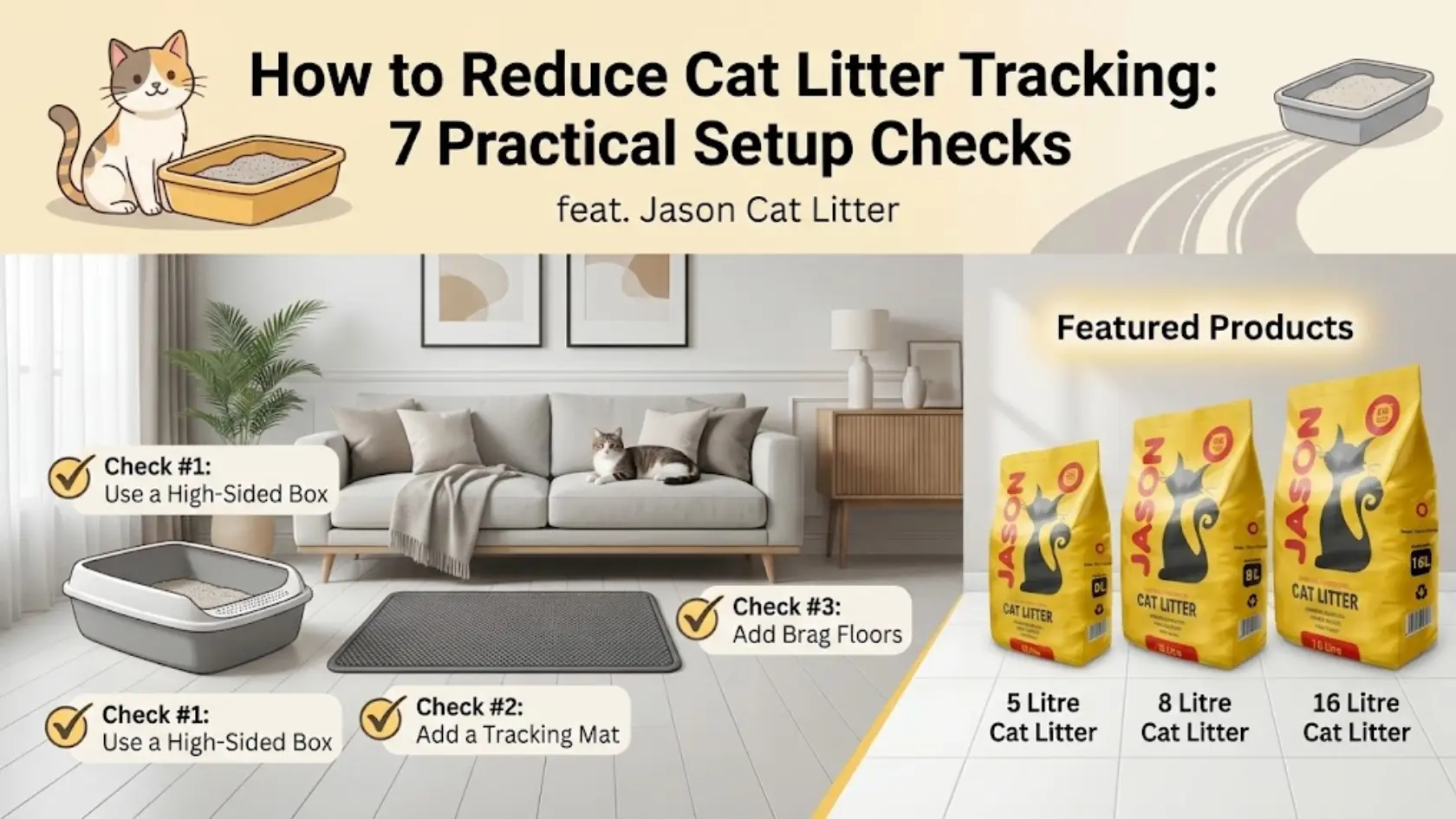
JASON cat litter comes in three sizes: 5 litre, 8 litre and 16 litre. The packaging describes it as a clumping formula with advanced absorption, made from a natural product and designed to be long lasting. Clumping litter suits a tracked switch well, because you can count and size the urine clumps each day.
| Bag | Best for during a switch | Why |
| JASON 5 Litre Cat Litter | Trial run, kittens, small boxes | Lets you test acceptance at the 25% and 50% stages before committing |
| JASON 8 Litre Cat Litter | One cat, one standard box | Typically covers the full 14-day transition with top-ups |
| JASON 16 Litre Cat Litter | Multi-cat homes, larger or covered boxes | Enough to switch several boxes at once and keep a reserve |
Usage varies with box size, fill depth and how many cats you have, so treat these as starting points. A simple rule: buy enough new litter to fill your box(es) about twice, so you never run short mid-switch and have to reverse progress.
Tips for a Smooth Switch to JASON
- Start the 25% stage with JASON mixed evenly into your current litter.
- Scoop clumps daily; with a clumping litter, clump count is your best tracking signal.
- Store the bag sealed and dry so the litter keeps its texture between top-ups.
Your Guide to Common Questions
Q1. How long does it take to switch cat litter?
Most cats adjust to a new litter in 7-14 days when it is mixed in gradually. Sensitive, senior or anxious cats may need 3-4 weeks. Let your cat's behaviour, not the calendar, decide when to move to the next stage.
Q2. Can I mix old and new cat litter?
Yes. Mixing old and new cat litter is the recommended way to switch. Start with about 25% new litter and increase in steps of 25% every few days until you reach 100%.
Q3. What if my cat won't use the new litter?
Go back one stage to the last ratio your cat accepted and stay there for 2-3 days. Add a second box with only the old litter if accidents happen. If your cat still refuses after a week, try a litter with a texture closer to the old one.
Q4. Can I switch cat litter all at once?
You can, but it is riskier. An abrupt switch can cause litter aversion and accidents. A gradual change with a daily tracking log is the safer default for most cats.
Q5. What should I track when changing cat litter?
Track box visits, the number and size of urine clumps, stools and whether they are buried, signs of hesitation, and any accidents. Compare each day with a 2-3 day baseline recorded before the switch.
Q6. Why is my cat peeing outside the box after a litter change?
Usually it signals dislike of the new litter's texture or scent. Step back one stage and clean accident spots with an enzyme cleaner. If your cat strains or produces little urine, see a vet the same day.
Q7. Do kittens need a gradual litter switch?
Yes, especially newly adopted kittens. Ask the breeder or shelter which litter they used, start with that, and transition over 1-2 weeks once the kitten is settled.
Q8. How do I switch litter with multiple cats?
Switch all boxes on the same schedule, but keep one box on the old litter until every cat uses the new mix reliably. Follow the one-box-per-cat-plus-one rule.
Q9. Is clumping litter good for a gradual switch?
Yes. Clumping litter, such as JASON cat litter, makes tracking easier because you can count and size urine clumps every day and spot changes quickly.
Conclusion: Switch Slowly, Track Daily, and Let Your Cat Set the Pace
A successful cat litter switch comes down to three habits: record a baseline, mix in the new litter in 25% steps over 7-14 days, and log your cat's box use every day. The log tells you when to advance, when to hold, and when to step back. It also flags the rare cases where a vet visit matters more than the litter.
Ready to Make the Switch?
Try JASON cat litter with this checklist. Start with the 5 Litre bag to test acceptance, choose the 8 Litre for a single cat, or stock up with the 16 Litre for multi-cat homes. Save or print the tracking log above, and begin your baseline today. Shop JASON products →